1
Enclosures & cases
Rev light bar housing for an 8-LED stick
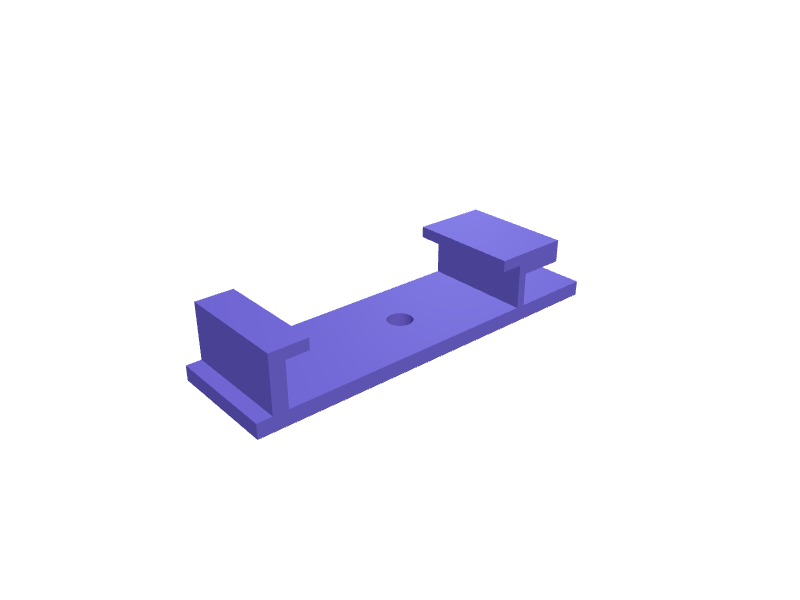
A housing that turns an 8-LED WS2812 stick into a rev light bar for a sim racing dash. The stick, about 51 × 10 mm, drops into a pocket from the back and is held by a press-in plate; the front has a 47 × 6 mm window with a 1 mm recess for a strip of diffuser, and an ear at each end takes an M3 screw, 66 mm apart. The body is 56 × 15 × 8.5 mm with walls of about 2 mm. Print it front face down in black filament, without supports. Describe your measurements and SpeakCAD builds it with AI (credits), then download STL, 3MF or sliced G-code.No ready-made model yet: building it uses credits (4 credits for the part on a plan, its first 3 small changes free; Maker: 50 credits a month for $7.99, cancel anytime).Updated
No ready-made model for this part yet
Sign in and SpeakCAD builds it from the prompt below (4 credits for the part on a plan, its first 3 small changes free; Maker: 50 credits a month for $7.99, cancel anytime). Want to try the editor first? The live demo is free, no account.2
Adjust
Change its numbers in the viewer for free, or ask the AI for a change in the chat (2 credits for a small change, 1 for a quick edit, 3 for a redesign; the first 3 small changes are free on a plan).3Print
Download a watertight STL or 3MF, included in every plan (4 credits without one), or G-code sliced for your printer at the same price.
Example prompt
Model a rev light housing for a sim racing dash that takes an 8-LED WS2812 stick of 51 × 10 mm. Body 56 × 15 × 8.5 mm: at the back a pocket 51.6 × 10.6 mm and 5.5 mm deep for the stick (0.3 mm clearance per side), in the 3 mm front wall a window 47 × 6 mm, and around the window a recess 51 × 10 mm and 1 mm deep for a diffuser strip. A 6 × 3 mm wire notch in one end wall at the back. One mounting ear at each end, 10 mm long and 3 mm thick, flush with the back, with 3.4 mm holes 66 mm apart for M3 screws. A separate back plate 51.2 × 10.2 × 2 mm that presses into the pocket. Print the body front face down and the plate flat, no supports.
Fit notes
LED sticks sold under the same name are not the same board: clones are often a few millimetres longer, and some carry the solder pads on the end instead of the back. A housing printed from a fixed file then pinches the board or leaves it loose. Type the length, width and thickness of your stick into SpeakCAD and the pocket, window and wire notch follow.
Questions people ask about a rev light bar housing for an 8-LED stick
A housing that turns an 8-LED WS2812 stick into a rev light bar for a sim racing dash. The stick, about 51 × 10 mm, drops into a pocket from the back and is held by a press-in plate; the front has a 47 × 6 mm window with a 1 mm recess for a strip of diffuser, and an ear at each end takes an M3 screw, 66 mm apart. The body is 56 × 15 × 8.5 mm with walls of about 2 mm. Print it front face down in black filament, without supports.
There is no ready-made model for this part yet. Click Build it with AI and sign in: the example prompt on this page is filled in, and SpeakCAD builds the part from it in your browser (4 credits for the part on a plan, its first 3 small changes free). Change any number in the viewer for free, then download a watertight STL or 3MF, included in every plan (4 credits without one), or G-code sliced for your printer at the same price. Start with Maker: 50 credits a month for $7.99, cancel anytime.
SpeakCAD builds it to your measurements from the example prompt on this page: the part uses 4 credits on a plan, its first 3 small changes free (3 without a plan), and a small change after them 2, then the STL or 3MF download is included in every plan (4 credits without one), or G-code sliced for your printer at the same price. Start with Maker: 50 credits a month for $7.99, cancel anytime. To try the editor before paying, the live demo is free, no account.
A shared STL is modelled for someone else's measurements. SpeakCAD builds this part to the millimetres you give it (AI requests use credits), so the file you download is sized for the part you actually own.
Yes. SpeakCAD slices the part on its servers with OrcaSlicer and your printer's official profile (380+ printers, including Bambu Lab, Prusa, Creality and Elegoo), and you download the G-code (a sliced .gcode.3mf for Bambu Lab printers). G-code sliced for your printer costs the same as the STL: included in every plan, free for a part you shaped by hand, 4 credits without a plan for a part with AI work in it. Pick your printer on the printers page to see its profile.
No. SpeakCAD runs in the browser on your phone or computer: the chat, the 3D engine and the live viewer load in the tab. The only file you download is the finished STL, 3MF or sliced G-code.
Print it your way
Make one to your sizes
More enclosures & cases
Case for an LM2596 buck converter moduleReady-made, opens free. A tidy shell for the common 43 x 21 mm LM2596 step-down module, covering the exposed inductor and trimmer while leaving the input and output terminals reacha…AirTag luggage tag holder with screw-closed caseReady-made, opens free. A luggage tag that hides an Apple AirTag (31.9 mm diameter, 8 mm thick) inside a screw-closed case so it cannot be prised out in transit, with a loop for a c…Raspberry Pi Zero 2 W slim snap-fit caseReady-made, opens free. A minimal shell for the Raspberry Pi Zero 2 W, which measures 65 x 30 mm with four M2.5 holes on a 58 x 23 mm pattern.Flipper Zero hard shell case with GPIO coverReady-made, opens free. A bumper-style protective shell for the Flipper Zero, whose body is 100 x 40 x 25 mm.Apple Watch Series 11 travel charger caseReady-made, opens free. A two-part clamshell that holds an Apple Watch Series 11 (about 46 mm case) on its magnetic charger plus a 1 m USB-C cable coiled in a 70 mm spiral.Sonoff MINIR4M junction-box insertReady-made, opens free. An insert that holds a MINIR4M in a 80 × 80 mm junction box with strain-relief slots.