Use case
Gears, pulleys, knobs and simple mechanisms
Mechanical parts have precise definitions, and SpeakCAD speaks that language: module, pressure angle, tooth count, bore, keyway, hub. Describe the pair you need and get meshing gears laid out on the bed.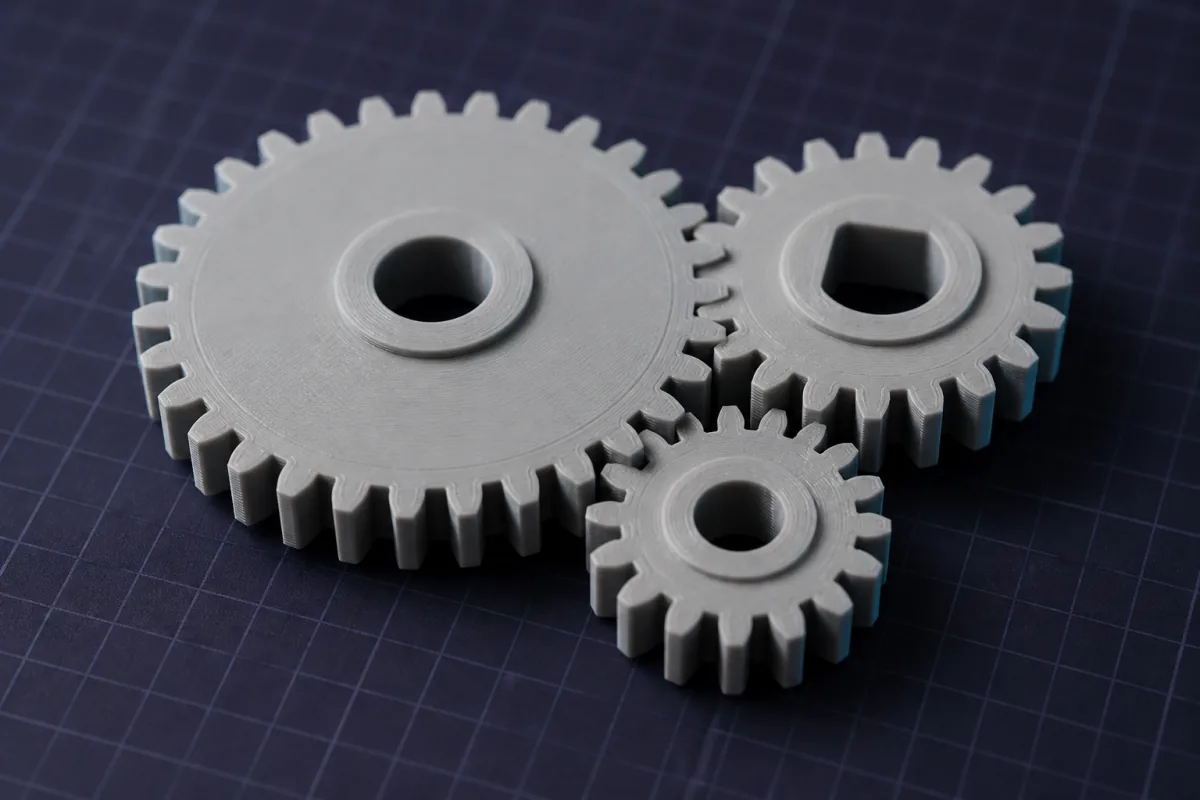
Prompts that work
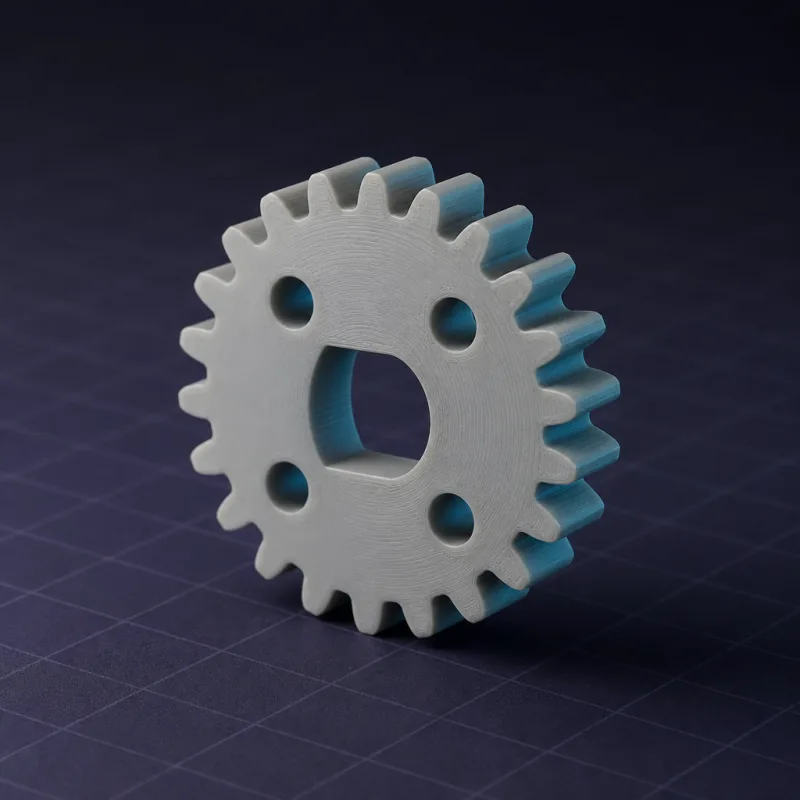
Copy one into the box above and change the numbers to yours. The first render usually appears within a minute or two.“A 24-tooth spur gear, module 2, 8 mm thick, 6 mm D-shaft bore with 0.5 mm flat, 4 lightening holes, and a matching 12-tooth pinion.”
“A GT2 pulley with 20 teeth, 6 mm belt, 5 mm bore, set screw hole M3, flanges 1 mm.”
“A ratchet wheel 40 mm diameter with 12 teeth and a matching pawl, 5 mm thick, 4 mm pivot holes.”
Gears from parameters
Give module (or pitch), tooth count and thickness. SpeakCAD generates involute-approximated teeth with the correct pitch diameter so two gears mesh at the sum of their pitch radii, and tells you that centre distance in the reply.
Bores, hubs and shafts
D-shafts, keyed shafts, hex bores, set-screw hubs and press-fit bearings (608, 625, 623) are all a phrase away. Clearances follow FDM practice: 0.2 mm on a bore that must not spin, 0.4 mm on a free-running one.
Simple mechanisms
Racks and pinions, ratchets and pawls, cams, lever arms, snap hinges, living hinges for PP and PETG, and geneva drives. For anything with moving parts, print a test pair first; thanks to the free re-download rule, adjusting the backlash spends only the requests that change it (2 credits each), or nothing if you type the new value in the dimensions panel.
Examples from the gallery
Questions
They are close polygonal approximations of involute profiles, which is what most printed gears use. For high-speed or high-load gears, plan a test print and fine-tune the profile shift by chat.
Yes. Ask for the pair and it lays them out side by side with the correct centre distance mentioned in the answer.
Related use cases
Replacement partsBroken knob, clip, hinge or foot? Describe it with a few measurements and SpeakCAD generates a printable STL replacement in minutes. From $7.99 a month.Brackets & mountsDescribe what you need to hold, where it mounts and which screws you have. SpeakCAD generates a strong, printable bracket as STL, 3MF or G-code sliced for your printer in minutes.EnclosuresDescribe your PCB size, ports and mounting, get a snap-fit or screwed enclosure as a print-ready STL, 3MF or G-code sliced for your printer. Raspberry Pi, Arduino, ESP32, sensor boxes.