Use case
Planters, vases and home decor with exact dimensions
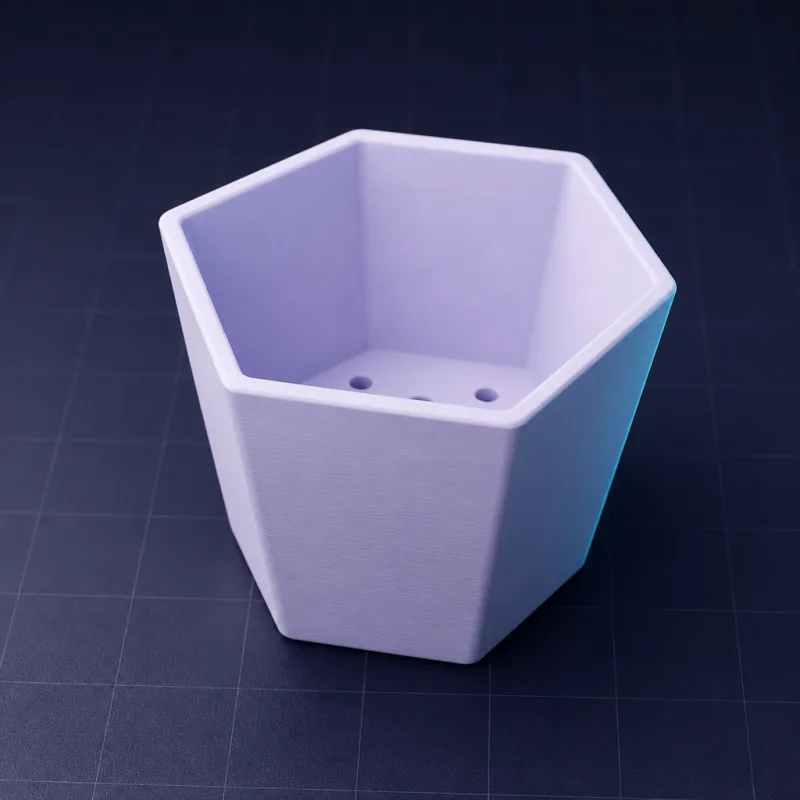
Geometric planters and vases are where a text description shines: “a hexagonal planter 90 mm across with a slight taper and three drainage holes” is a complete spec. SpeakCAD gets the proportions right and keeps the walls printable.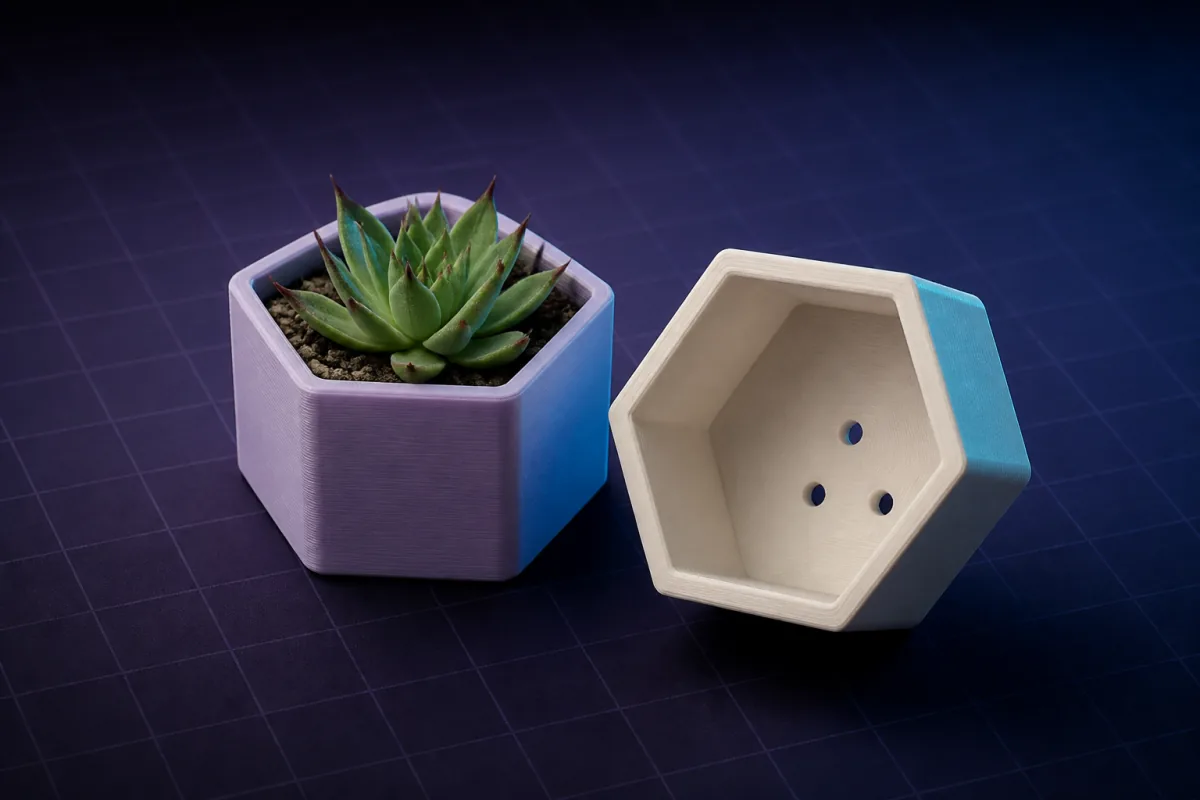
Prompts that work
Copy one into the box above and change the numbers to yours. The first render usually appears within a minute or two.“A hexagonal planter 90 mm across and 80 mm tall, 2.4 mm walls, 3° taper, three 6 mm drainage holes, matching saucer with a 3 mm lip.”
“A twisted vase 60 mm base, 120 mm tall, 12 facets rotated 30° over the height, single wall for spiral vase mode.”
“A self-watering planter: 100 mm diameter inner pot with 4 mm wicking slots, outer reservoir 25 mm deep, fill window on the side.”
Styles you can ask for
Faceted, fluted, twisted, ribbed, stepped, low-poly, smooth with fillets. Specify the number of facets or ribs and the twist angle; the AI builds the profile and extrudes it with the right resolution for smooth curves.
Drainage, saucers and self-watering
Ask for drainage holes (count and diameter), a matching saucer with a lip, or a two-part self-watering design with a reservoir and wicking slots. Each piece is laid out on the bed ready to print.
Vase mode
If you want to print in spiral vase mode, say so: SpeakCAD produces a single closed outline with a solid base so your slicer's vase setting works without overhang or gap issues.
Examples from the gallery
Questions
Yes. Give the pot's top diameter and height, and ask for 2 mm clearance; the outer planter will hide the pot with a rim.
PLA works indoors. For outdoor or wet use, PETG or ASA is better; the geometry is the same.
Related use cases
Cookie cuttersDescribe a shape or upload a sketch and get a cookie cutter with a sharp blade and comfortable flange, ready to print in PLA or PETG. STL, 3MF or G-code for your printer.OrganizersDescribe your drawer or shelf and what goes in it. SpeakCAD generates dividers, trays, bit holders and bins sized to the millimetre. STL, 3MF or sliced G-code export.Phone & tablet standsGenerate a phone or tablet stand that matches your device width, case thickness, viewing angle and cable slot. Download STL, 3MF or G-code sliced for your printer in minutes.