Enclosures for tiny boards: Seeed XIAO, Adafruit QT Py, ESP32 SuperMini and Feather, 3D printed
Boards under 25 mm wide need 1.5 mm walls, antenna keep-outs and room for a USB-C plug. Dimensions for XIAO, QT Py, SuperMini and Feather, plus wearable prompts.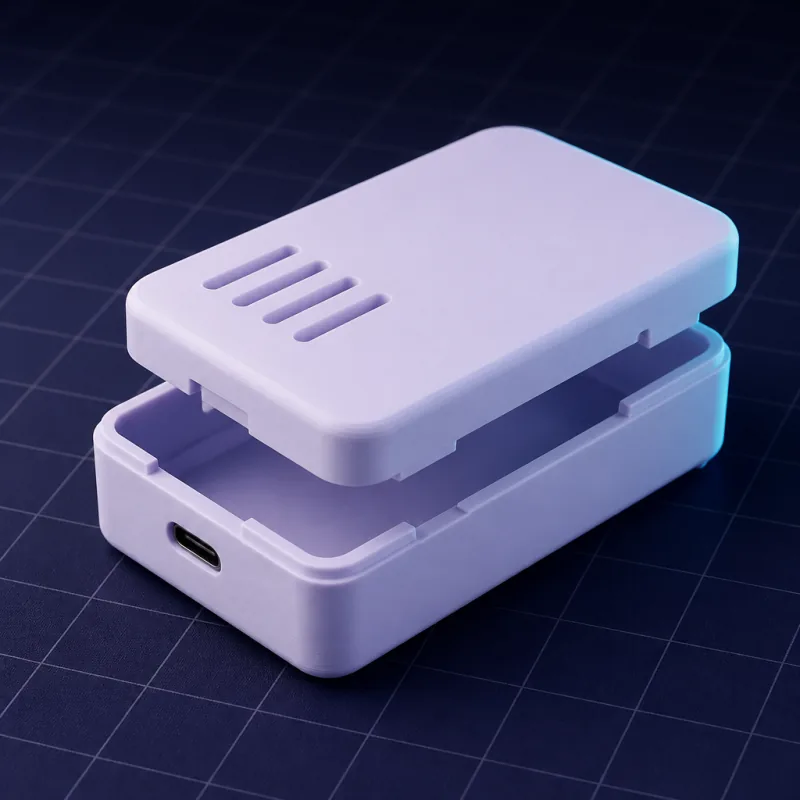
The boards
| Board | Outline | USB | Holes | Notes |
|---|---|---|---|---|
| Seeed XIAO (all variants) | 21 x 17.8 mm | USB-C | None | ESP32-C3/S3 have an external antenna connector; nRF52840 has a chip antenna |
| Adafruit QT Py | 22 x 18 mm | USB-C | None | STEMMA QT connector on the far edge |
| ESP32-C3 / S3 SuperMini | 22.5 x 18 mm | USB-C | None | Ceramic antenna at one corner |
| Adafruit Feather | 51 x 23 mm | Micro-B or USB-C | 4 x 2.5 mm on a 45.7 x 17.8 mm pattern | JST battery connector on the short edge |
| Feather + FeatherWing | 51 x 23 mm, stack about 20 mm tall | Same |
The XIAO, QT Py and SuperMini are so close in size that one case design serves all three; only the antenna keep-out and the connector on the far edge change.
Rules for small cases
- Walls 1.5 mm. Enough at this size; 2 mm walls make a 21 mm board look like a 30 mm box.
- Clearance 0.3 mm. Small boards do not need the 0.5 to 1 mm of a Pi.
- USB-C plug recess. The plug overmould is about 12 x 6.5 mm. A 9 x 3.5 mm hole clears the connector; add a 12.5 x 7 mm outside recess so the plug seats.
- Antenna. Leave 3 mm of air at the antenna corner. The AI adds the keep-out when you say which board it is.
- Battery. Many of these boards charge a LiPo. A 402030 cell is 30 x 20 x 4 mm; ask for a cell pocket under the board and the case becomes a wearable.
The prompt (XIAO wearable)
The prompt (Feather stack)
Keychains and clips
"Add a 5 mm keyring loop on one corner" or "a 20 mm spring clip on the back" turns any of these into something you carry. The XIAO ESP32-C3 keychain case, the ESP32-C3 SuperMini case with sensor vents and the Feather case with a FeatherWing stack are in the library, pre-filled.
Prompts to start from
Open one in the builder, change the numbers to yours, and the model renders in your browser, usually within a minute or two. Keep adjusting in the chat before you print.A wearable case for a Seeed XIAO nRF52840 Sense, board 21 x 17.8 mm, USB-C on one short edge, with a 402030 LiPo (30 x 20 x 4 mm) in a pocket under the board. 1.5 mm walls, 0.3 mm clearance, 12 mm internal height total. A 9 x 3.5 mm USB-C cutout with a 12.5 x 7 mm outside recess, a 3 mm hole in the lid above the LED, two 12 x 2 mm slots on the sides for a 12 mm watch strap, friction lid. Total size about 36 x 24 x 15 mm.
A case for an Adafruit Feather with one FeatherWing stacked on top, board 51 x 23 mm with four 2.5 mm holes on a 45.7 x 17.8 mm pattern, stack height 20 mm. 3 mm standoffs with 2.2 mm pins, 1.6 mm walls, 0.5 mm clearance, 24 mm internal height. USB-C cutout and a 10 x 6 mm JST battery slot on the short edge, the lid open above the FeatherWing, snap-fit.
A keychain case for an Adafruit QT Py, board 22 x 18 mm, USB-C on one short edge and a STEMMA QT connector on the other: 1.5 mm walls, 0.3 mm clearance, 7 mm internal height, USB-C cutout with an outside plug recess, a 6 x 3 mm slot for the STEMMA cable, a 5 mm keyring loop, snap lid.
Questions
Nearly. They are all about 22 x 18 mm with USB-C on a short edge. The connector on the far edge (STEMMA QT on the QT Py) and the antenna corner differ, so name the board and the keep-out and slot are placed correctly.
The plug's overmould is wider than the connector. Ask for a 12.5 x 7 mm recess on the outside of the USB hole so the plug body clears the wall.
Yes. Give the cell size (402030 is 30 x 20 x 4 mm, 502030 is 30 x 20 x 5 mm) and ask for a pocket under or beside the board. The AI keeps 1 mm of foam space so the cell is not pinched.