3D printed Arduino Uno enclosure: dimensions, hole pattern and a prompt that fits
The exact Uno R3 and R4 footprint (68.6 x 53.4 mm, four irregular holes), where the USB and barrel jack sit, and a ready prompt for a snap-fit case with a shield slot.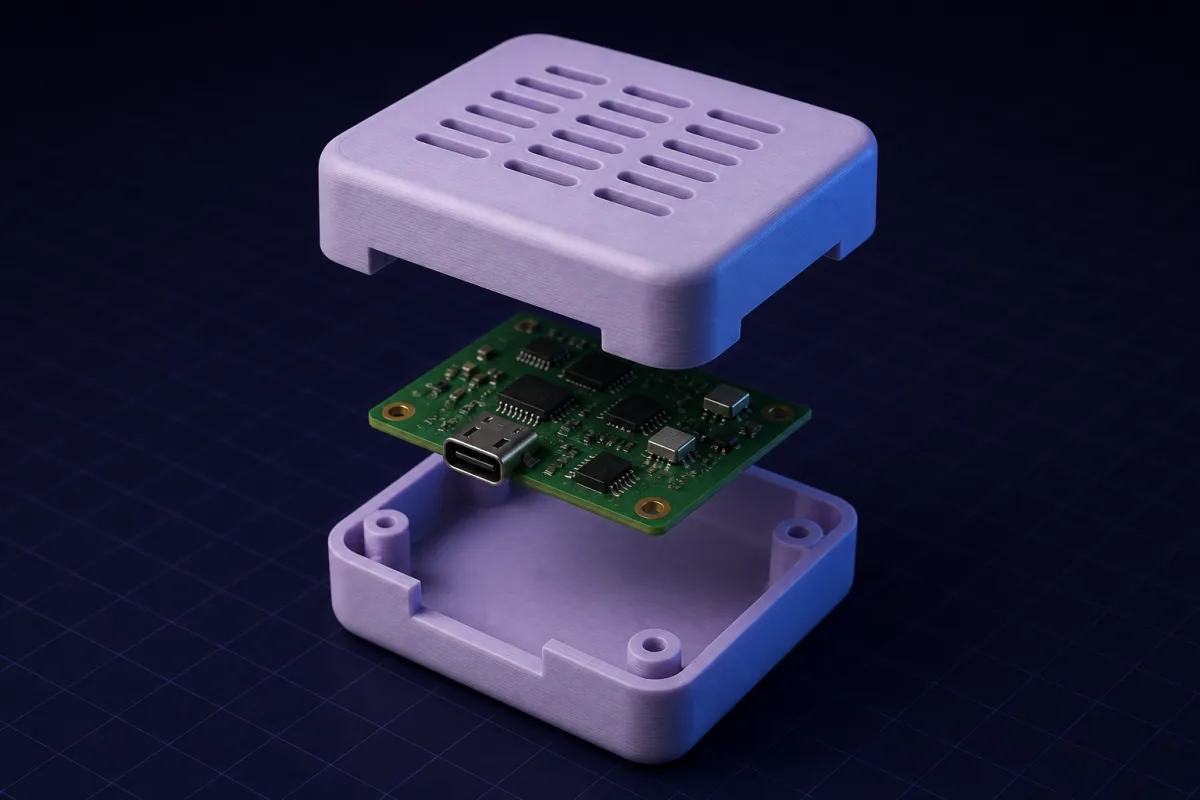
The Uno footprint
The Arduino Uno R3, the Uno R4 Minima and the Uno R4 WiFi share the same board outline and hole pattern, which is why shields fit all three.
| Measurement | Value |
|---|---|
| Board outline | 68.6 x 53.4 mm |
| Board thickness | 1.6 mm |
| Mounting holes | 4, about 3.2 mm diameter |
| Hole positions (from the corner nearest the USB jack) | (14.0, 2.5), (15.3, 50.7), (66.1, 7.6), (66.1, 35.5) mm |
| USB connector | USB-B on the R3, USB-C on the R4, on the short edge, overhangs the board by about 6 mm on the R3 |
| Barrel jack | 2.1 mm, same short edge, about 8 mm from the corner, overhangs by 2 mm |
| Tallest component | USB-B jack on the R3 at 11 mm; headers at 8.5 mm |
The holes are not symmetrical. Any case that "looks about right" will miss at least one of them, which is why so many downloaded Uno cases use only two screws.
What to decide before prompting
- Does a shield go on top? If yes, add 12 to 15 mm of internal height per shield and leave the header rows reachable through a slot in the lid.
- Which side opens? A lid on top is the default. A sliding end panel lets you slide the board in with cables attached.
- Screws or snaps? M3 screws into the four standoffs hold the board; the lid can still be a snap fit.
- R3 or R4? The R4 has USB-C and, on the WiFi version, a 12 x 8 LED matrix worth a window.
The prompt
The AI places the standoffs at those coordinates, positions the cutouts against the board's edge and reports the internal dimensions it used. Preview it, orbit around it, then adjust.
Typical edits after the first render
- "Add a 30 x 12 mm slot on the opposite short edge for jumper wires"
- "Make the lid screwed with M3 into corner pillars instead of snap-fit"
- "Add four wall-mount keyholes on the bottom"
- "Emboss 'UNO' 1 mm high on the lid"
- "Add a 14 x 10 mm window above the LED matrix" (R4 WiFi)
Printing notes
Base and lid open side up, no supports, 0.2 mm layers, three perimeters. The USB-B cutout is tall enough that the top of it becomes a short bridge; it prints fine at 12 mm. If your printer prints wide, ask for 0.1 mm more clearance on the snap lip.
Related library part
The library has a ready snap-lid enclosure for an Arduino Uno and an Uno R4 WiFi case with a LED matrix window; both open in the builder pre-filled.
Prompts to start from
Open one in the builder, change the numbers to yours, and the model renders in your browser, usually within a minute or two. Keep adjusting in the chat before you print.A snap-fit enclosure for an Arduino Uno R3, board 68.6 x 53.4 mm, standoffs 4 mm tall with 3.2 mm holes at (14.0, 2.5), (15.3, 50.7), (66.1, 7.6) and (66.1, 35.5) mm from the corner nearest the USB jack. 2 mm walls, 1 mm clearance around the board, 25 mm internal height. Cutouts on the USB short edge for a USB-B jack (12 x 11 mm, 3 mm above the board) and a 2.1 mm barrel jack (9 x 11 mm). Lid with a 50 x 8 mm slot above each header row.
A case for an Arduino Uno R4 WiFi (68.6 x 53.4 mm, Uno hole pattern) with a USB-C cutout, a barrel jack cutout, 20 mm internal height, screwed lid with M3 corner pillars and a 32 x 22 mm window in the lid above the LED matrix.
A slim tray for an Arduino Uno with standoffs at the Uno hole pattern, no lid, 3 mm base, four wall-mount keyholes and a cable tie loop on each long side.
Questions
Almost. The outline and holes match, so the same base fits both. The USB cutout differs: USB-B on the R3, USB-C on the R4. Ask for the connector you have and the cutout is sized for it.
Because the four Uno holes are not symmetrical and a hand-drawn case rarely hits all of them. Giving the coordinates to the generator places all four standoffs exactly.
A shield stacked on the Uno adds about 12 mm plus its own tallest component. Plan 25 mm internal height for one shield, 38 mm for two, and leave a slot in the lid above the headers.