1
Desk & office
Vertical laptop stand for closed-lid docking
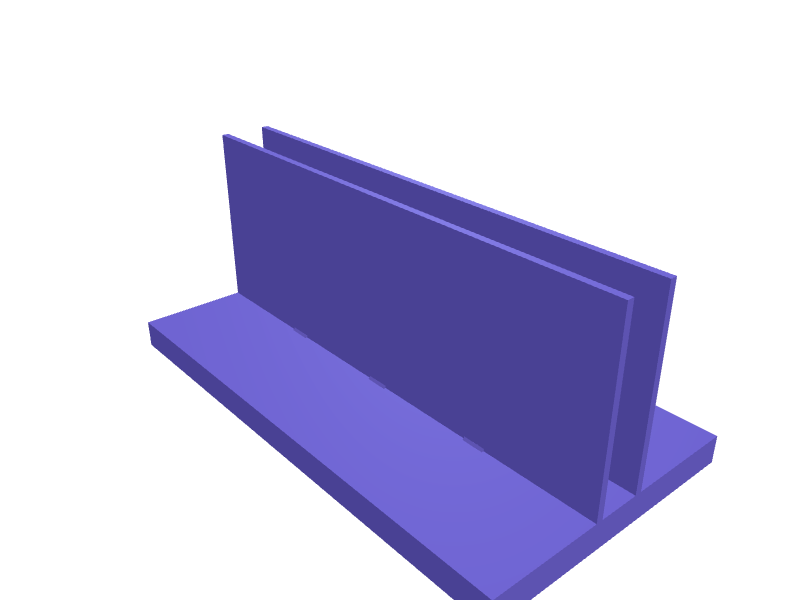
A weighted-look holder that stores a closed laptop on its edge beside a monitor. The slot is sized to the laptop thickness plus 2 mm of clearance, lined with 1.5 mm pads at the contact points to protect the finish, and 40 mm deep so the machine cannot topple. A 12 mm thick base with a 120 mm footprint provides stability, ventilation gaps in the slot floor let heat escape, and a rear channel routes the power cable. Open the ready-made model free, resize it on your phone or computer, then download a print-ready STL, 3MF or G-code sliced for your printer, free.Opening the ready-made model and downloading it as STL or 3MF are free, no card; AI changes use credits, from Maker at $7.99 a month.No printer? We print this part and ship it to your door. See its priceUpdated
2
Adjust
Change its numbers in the viewer for free, or ask the AI in the chat: wall thickness, hole size, the thing it clips onto. AI changes use 2 credits per request (1 for a quick edit, 3 for a redesign), paid with a plan from Maker at $7.99 a month.3Print
Download a watertight STL or 3MF free, with your numbers and hand edits, or G-code sliced for your printer at the same price. After an AI change the download is included in every plan (4 credits without one).
Dimensions of the ready-made model (editable)
| Parameter | Value |
|---|---|
| inner slot width for laptop edge | 18 mm |
| length of slot (matches base length) | 220 mm |
| pad thickness inside slot walls | 1.5 mm |
| structural wall thickness of slot | 3 mm |
| base plate thickness | 12 mm |
| base plate depth (front-back) | 120 mm |
| base plate length (matches slot length) | 220 mm |
| ventilation gap width | 10 mm |
| rear cable channel width | 10 mm |
| depth of channel cut into base rear | 12 mm |
Example prompt
Design a vertical laptop stand with a slot 18 mm wide, 40 mm deep and 220 mm long with 1.5 mm pads inside, 12 mm thick base 120 mm deep, three 10 mm ventilation gaps in the slot floor, a 10 mm cable channel at the rear.
Fit notes
Laptops range from 10 to 25 mm thick, so a stand generated around your model's exact dimensions grips properly where a generic one wobbles. Give SpeakCAD the thickness and width, view the stand in your browser, adjust the angle or add a second slot for a tablet, and download the STL when it fits.
Questions people ask about a vertical laptop stand for closed-lid docking
A weighted-look holder that stores a closed laptop on its edge beside a monitor. The slot is sized to the laptop thickness plus 2 mm of clearance, lined with 1.5 mm pads at the contact points to protect the finish, and 40 mm deep so the machine cannot topple. A 12 mm thick base with a 120 mm footprint provides stability, ventilation gaps in the slot floor let heat escape, and a rear channel routes the power cable.
Click Open it free on this page and create a free account (no card): the ready-made model opens in your browser, on your phone or computer, nothing to install. Change its numbers in the viewer for free and download a watertight STL or 3MF free, or G-code sliced for your printer at the same price. An AI change in the chat uses 2 credits per request (3 for a redesign), and the download after it is included in every plan (4 credits without one). Start with Maker: 50 credits a month for $7.99, cancel anytime.
On this page: open the ready-made model free in a SpeakCAD account (no card), change any dimension in the viewer, then download the STL or 3MF free, or G-code sliced for your printer at the same price.
A shared STL is modelled for someone else's measurements. Here you open the ready-made model free, change it to your measurements in the viewer, then download a file sized for the part you actually own, free as STL or 3MF.
Yes. SpeakCAD slices the part on its servers with OrcaSlicer and your printer's official profile (380+ printers, including Bambu Lab, Prusa, Creality and Elegoo), and you download the G-code (a sliced .gcode.3mf for Bambu Lab printers). G-code sliced for your printer costs the same as the STL: included in every plan, free for a part you shaped by hand, 4 credits without a plan for a part with AI work in it. Pick your printer on the printers page to see its profile.
No. SpeakCAD runs in the browser on your phone or computer: the chat, the 3D engine and the live viewer load in the tab. The only file you download is the finished STL, 3MF or sliced G-code.
Print it your way
More desk & office
Sony WH-1000XM6 under-desk hangerReady-made, opens free. An under-desk hanger for Sony WH-1000XM6 headphones (about 190 mm headband span) with a 22 mm saddle, a 6 mm clamp that grabs a 15–30 mm desktop, and a 10 mm…Midi Fighter 3D angled standReady-made, opens free. A 20 degree stand for a Midi Fighter 3D with a 14 mm USB slot and 10 mm rubber-foot recesses.MacBook Pro 16-inch M4 Pro vertical standReady-made, opens free. A vertical stand for a 16-inch MacBook Pro M4 Pro (about 16.8 mm closed, 356 mm wide) with a 18 × 358 mm slot, a 24 mm MagSafe cutout and a 160 × 110 mm base.iPad Pro 11-inch M4 Pencil charging standReady-made, opens free. A stand that holds an 11-inch iPad Pro M4 (about 250 × 177 × 5.3 mm) at 60 degrees for StandBy and parks an Apple Pencil Pro on a 9 mm MagSafe saddle.Two-piece tablet stand with adjustable angleReady-made, opens free. A cradle and a folding prop that together hold a tablet at 30, 45 or 60 degrees.Elgato Stream Deck MK.2 under-monitor mountReady-made, opens free. A bracket that hangs an Elgato Stream Deck MK.2 below the bottom edge of a monitor so it stays in reach without a footprint on the desk.