1
Brackets & mounts
Pedaltrain Classic pedalboard riser for Boss pedals
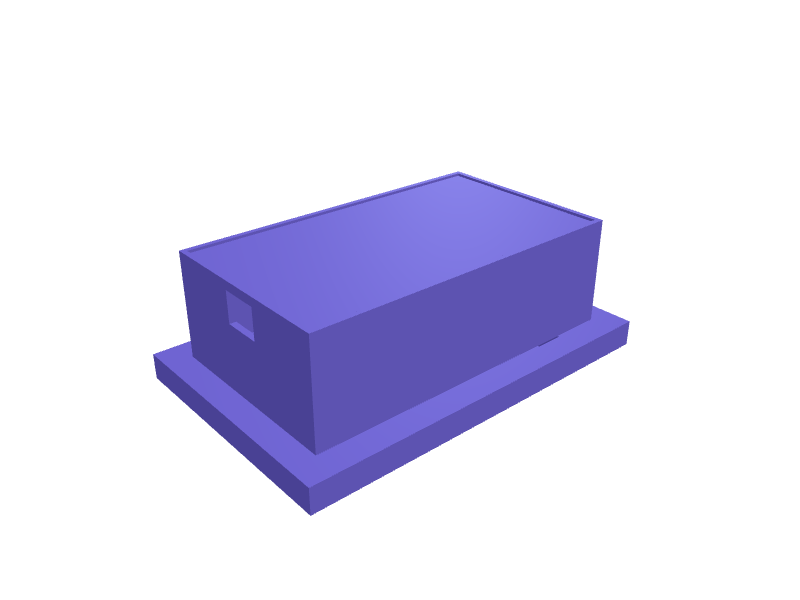
A rear-row riser that clips onto the two back rails of a Pedaltrain Classic or Classic Jr and lifts a Boss compact pedal (73 x 129 x 59 mm) by 40 mm so its footswitch clears the pedals in front. The Pedaltrain rails are aluminium with a roughly 20 mm wide top face and 35 mm gaps between rails, so the riser has 21 mm channels with 0.4 mm clearance that snap over two rails, and a 75 x 130 mm top plate with a 1 mm lip that keeps the Boss housing square while hook-and-loop holds it down. It also suits Strymon and Electro-Harmonix nano pedals. Print it upside down with 2.5 mm walls and 25 percent infill. Open the ready-made model free, resize it on your phone or computer, then download a print-ready STL, 3MF or G-code sliced for your printer, free.Opening the ready-made model and downloading it as STL or 3MF are free, no card; AI changes use credits, from Maker at $7.99 a month.No printer? We print this part and ship it to your door. See its priceUpdated
2
Adjust
Change its numbers in the viewer for free, or ask the AI in the chat: wall thickness, hole size, the thing it clips onto. AI changes use 2 credits per request (1 for a quick edit, 3 for a redesign), paid with a plan from Maker at $7.99 a month.3Print
Download a watertight STL or 3MF free, with your numbers and hand edits, or G-code sliced for your printer at the same price. After an AI change the download is included in every plan (4 credits without one).
Dimensions of the ready-made model (editable)
| Parameter | Value |
|---|---|
| Pedaltrain rail width | 21 mm |
| snap-fit clearance | 0.4 mm |
| depth of snap channel groove | 8 mm |
| length of channel (front-to-back travel) | 90 mm |
| top plate width (X) | 75 mm |
| top plate length (Y) | 130 mm |
| height of riser box | 40 mm |
| wall thickness | 2.5 mm |
| perimeter lip height | 1 mm |
| perimeter lip wall width | 2 mm |
| rear cable slot width | 15 mm |
| rear cable slot height | 12 mm |
| extra base material around channels | 10 mm |
Example prompt
Design a pedalboard riser for a Pedaltrain Classic: two 21 mm wide snap channels with 0.4 mm clearance spaced 55 mm apart, a 75 x 130 mm top plate raised 40 mm with a 1 mm perimeter lip for a Boss compact pedal, cable slot 15 mm wide at the rear, 2.5 mm walls.
Fit notes
Rail pitch differs across Pedaltrain, Temple Audio and Holeyboard boards, so a generic riser wobbles. Tell SpeakCAD your board model and rail spacing, preview the riser in the browser, ask for a two-pedal version in the chat and download the STL.
Questions people ask about a Pedaltrain Classic pedalboard riser for Boss pedals
A rear-row riser that clips onto the two back rails of a Pedaltrain Classic or Classic Jr and lifts a Boss compact pedal (73 x 129 x 59 mm) by 40 mm so its footswitch clears the pedals in front. The Pedaltrain rails are aluminium with a roughly 20 mm wide top face and 35 mm gaps between rails, so the riser has 21 mm channels with 0.4 mm clearance that snap over two rails, and a 75 x 130 mm top plate with a 1 mm lip that keeps the Boss housing square while hook-and-loop holds it down. It also suits Strymon and Electro-Harmonix nano pedals. Print it upside down with 2.5 mm walls and 25 percent infill.
Click Open it free on this page and create a free account (no card): the ready-made model opens in your browser, on your phone or computer, nothing to install. Change its numbers in the viewer for free and download a watertight STL or 3MF free, or G-code sliced for your printer at the same price. An AI change in the chat uses 2 credits per request (3 for a redesign), and the download after it is included in every plan (4 credits without one). Start with Maker: 50 credits a month for $7.99, cancel anytime.
On this page: open the ready-made model free in a SpeakCAD account (no card), change any dimension in the viewer, then download the STL or 3MF free, or G-code sliced for your printer at the same price.
A shared STL is modelled for someone else's measurements. Here you open the ready-made model free, change it to your measurements in the viewer, then download a file sized for the part you actually own, free as STL or 3MF.
Yes. SpeakCAD slices the part on its servers with OrcaSlicer and your printer's official profile (380+ printers, including Bambu Lab, Prusa, Creality and Elegoo), and you download the G-code (a sliced .gcode.3mf for Bambu Lab printers). G-code sliced for your printer costs the same as the STL: included in every plan, free for a part you shaped by hand, 4 credits without a plan for a part with AI work in it. Pick your printer on the printers page to see its profile.
No. SpeakCAD runs in the browser on your phone or computer: the chat, the 3D engine and the live viewer load in the tab. The only file you download is the finished STL, 3MF or sliced G-code.
Print it your way
More brackets & mounts
Brompton handlebar mount for Garmin Edge computersReady-made, opens free. Brompton M and S bars have a 22.2 mm grip section and very little real estate once the brake levers and shifter are on, so a normal out-front mount does not…TP-Link Tapo C200 camera ceiling mount plateReady-made, opens free. An inverted mount plate for the TP-Link Tapo C200 pan and tilt camera, which is 86.6 x 85 x 117.7 mm and screws to a base with two holes about 50 mm apart.Chuckit ball launcher wall mount with ball holderReady-made, opens free. A garage or hallway mount that holds a Chuckit Classic 26M launcher upright by its handle and keeps two tennis balls ready beside it.Wyze Cam v4 eave mount with sun hoodReady-made, opens free. An eave bracket that hangs a Wyze Cam v4 (about 55 × 55 × 90 mm with the stand) under a soffit with a 20 mm sun hood.Dyson V10 cyclone tool railReady-made, opens free. A rail that hangs four V10 click-in tools beside the official wall dock so the crevice, combination and mini-motorhead are not on the floor.Adjustable support bracket for a sagging graphics cardReady-made, opens free. A telescoping pillar that stands on the PC case floor or power supply shroud and props up the far end of a heavy graphics card so it stops drooping in the PC…