1
Desk & office
Monitor riser with under-shelf storage
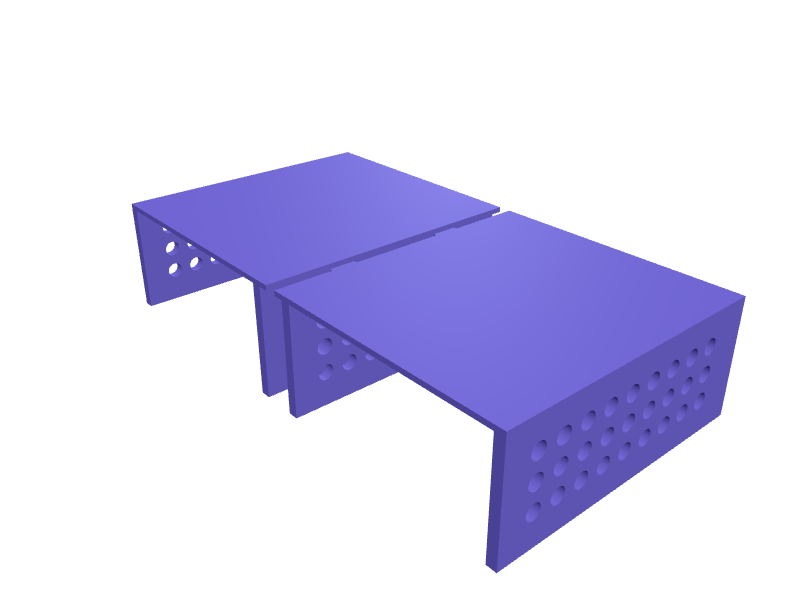
A platform that lifts a monitor 90 mm to eye height while the space beneath stores a keyboard, notebook or external drive. The top deck is 400 mm wide and 220 mm deep with a 3 mm lip at the back, supported by two side panels with 8 mm ribs, and it holds 15 kg thanks to a 4 mm deck reinforced by a honeycomb underside. It splits into two halves joined by dovetail keys and printed flat. Open the ready-made model free, resize it on your phone or computer, then download a print-ready STL, 3MF or G-code sliced for your printer, free.Opening the ready-made model and downloading it as STL or 3MF are free, no card; AI changes use credits, from Maker at $7.99 a month.No printer? We print this part and ship it to your door. See its priceUpdated
2
Adjust
Change its numbers in the viewer for free, or ask the AI in the chat: wall thickness, hole size, the thing it clips onto. AI changes use 2 credits per request (1 for a quick edit, 3 for a redesign), paid with a plan from Maker at $7.99 a month.3Print
Download a watertight STL or 3MF free, with your numbers and hand edits, or G-code sliced for your printer at the same price. After an AI change the download is included in every plan (4 credits without one).
Dimensions of the ready-made model (editable)
| Parameter | Value |
|---|---|
| total riser width | 400 mm |
| riser depth (matches bed depth) | 220 mm |
| total riser height | 90 mm |
| top deck thickness | 4 mm |
| rib / panel wall thickness | 8 mm |
| hex cell radius | 9 mm |
| solid border kept around honeycomb field | 14 mm |
| solid top skin thickness | 1.5 mm |
| dovetail base width (at panel face) | 20 mm |
| dovetail tip width (flared) | 28 mm |
| dovetail protrusion depth | 10 mm |
| per-side clearance for the socket | 0.3 mm |
Example prompt
Design a monitor riser 400 mm wide, 220 mm deep and 90 mm tall with a 4 mm top deck stiffened by a honeycomb underside, two side panels with 8 mm ribs, split into two halves with dovetail keys for a 220 x 220 mm bed.
Fit notes
Ergonomic height depends on your chair and monitor, so let SpeakCAD calculate the riser to your numbers and split it to your print bed. Open the ready-made model free, change its numbers in the viewer and download the STL or 3MF free; AI changes use credits.
Questions people ask about a monitor riser with under-shelf storage
A platform that lifts a monitor 90 mm to eye height while the space beneath stores a keyboard, notebook or external drive. The top deck is 400 mm wide and 220 mm deep with a 3 mm lip at the back, supported by two side panels with 8 mm ribs, and it holds 15 kg thanks to a 4 mm deck reinforced by a honeycomb underside. It splits into two halves joined by dovetail keys and printed flat.
Click Open it free on this page and create a free account (no card): the ready-made model opens in your browser, on your phone or computer, nothing to install. Change its numbers in the viewer for free and download a watertight STL or 3MF free, or G-code sliced for your printer at the same price. An AI change in the chat uses 2 credits per request (3 for a redesign), and the download after it is included in every plan (4 credits without one). Start with Maker: 50 credits a month for $7.99, cancel anytime.
On this page: open the ready-made model free in a SpeakCAD account (no card), change any dimension in the viewer, then download the STL or 3MF free, or G-code sliced for your printer at the same price.
A shared STL is modelled for someone else's measurements. Here you open the ready-made model free, change it to your measurements in the viewer, then download a file sized for the part you actually own, free as STL or 3MF.
Yes. SpeakCAD slices the part on its servers with OrcaSlicer and your printer's official profile (380+ printers, including Bambu Lab, Prusa, Creality and Elegoo), and you download the G-code (a sliced .gcode.3mf for Bambu Lab printers). G-code sliced for your printer costs the same as the STL: included in every plan, free for a part you shaped by hand, 4 credits without a plan for a part with AI work in it. Pick your printer on the printers page to see its profile.
No. SpeakCAD runs in the browser on your phone or computer: the chat, the 3D engine and the live viewer load in the tab. The only file you download is the finished STL, 3MF or sliced G-code.
Print it your way
More desk & office
Magic Mouse 2 charging flip standReady-made, opens free. A stand that holds a Magic Mouse 2 / USB-C Magic Mouse on its side so you can charge it without the cable pointing at the ceiling.MacBook Air 15 M4 MagSafe right-side clipReady-made, opens free. A clip that hangs from the right edge of a 15-inch MacBook Air M4 and holds the MagSafe 3 cable at chassis height so the tip does not scratch the aluminium.iPhone 16 Pro bedside MagSafe charging stand for StandByReady-made, opens free. A nightstand stand that holds an Apple MagSafe puck at 65 degrees so an iPhone 16 Pro (149.6 x 71.5 x 8.25 mm) charges in landscape and shows the StandBy clock.Akai MPK Mini MK3 keyboard stand with laptop shelfReady-made, opens free. A two-tier stand that lifts an Akai MPK Mini MK3 or MPK Mini Plus (318 x 181 x 44 mm) 20 mm off the desk at a 10 degree angle and raises a 13 to 16 inch lapt…Elgato Stream Deck Neo monitor-lip mountReady-made, opens free. A lip mount that hangs an Elgato Stream Deck Neo (about 140 × 85 × 20 mm) under a 4–32 mm monitor bezel.Universal Audio Volt 1 desk standReady-made, opens free. A 15 degree stand for a Volt 1 with a 14 mm USB slot.