25 prompts to design 3D printable parts in ChatGPT and Claude
Copy-paste requests for enclosures, mounts, holders, adapters and replacement parts, written so ChatGPT or Claude hands SpeakCAD every measurement it needs.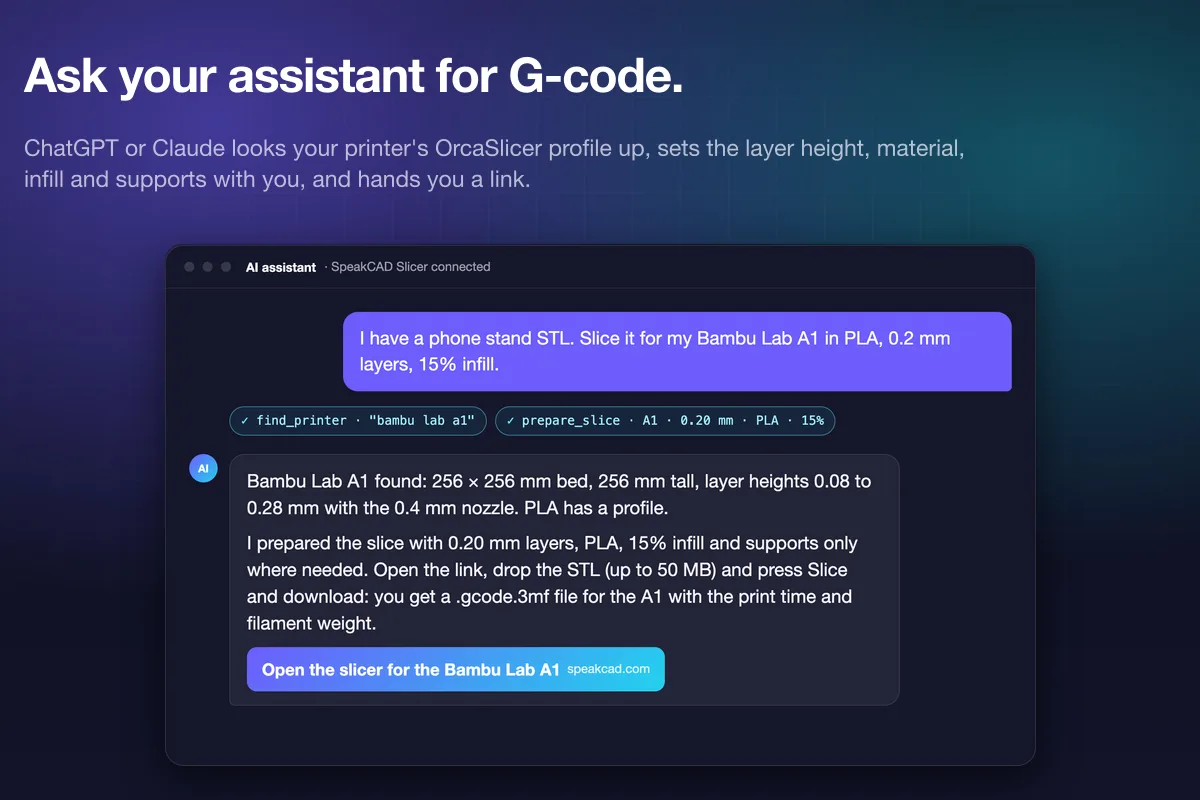
Every prompt below works as it is in ChatGPT with the SpeakCAD plugin or in Claude with the SpeakCAD connector, and in the SpeakCAD editor too. Start each one with "Use SpeakCAD to design…" (or pick SpeakCAD for the message) so the assistant hands it over instead of writing code itself. The first render usually appears within a minute or two: a new part gets deeper reasoning through the geometry, and small edits land in seconds.
The shape of a good request
Three things make the first version right:
- Measurements in millimetres. Outer size, wall thickness, hole sizes and spacing.
- What it fits or holds. The board, the pipe, the phone, the shelf. That sets the clearances.
- How it attaches. Screws (size and spacing), a clip, a snap-fit lid, tape.
Missing a number? Let the assistant ask: "I need a mount for my router. Ask me what you need to know, then design it with SpeakCAD."
Enclosures
- A case for a Raspberry Pi 5: 2 mm walls, a 30 mm fan cutout in the lid, openings for the USB-C, both micro-HDMI and the Ethernet port, and four rubber feet pockets.
- A two-part box for a 70 x 45 mm PCB with M3 holes 4 mm from each corner, 20 mm internal height, a screwed lid on four corner pillars, and a 9 x 4 mm USB-C cutout centred on one short side.
- An ESP32 DevKit enclosure with a snap-fit lid, slot vents on both long sides, a 6 mm hole for a status LED and a cable gland hole for a 5 mm cable.
- An Arduino Uno case that clips onto a 35 mm DIN rail, with openings for the USB-B and the barrel jack.
- A battery box for four AA cells in a row with a sliding lid and a 4 mm hole for the wires.
Wall mounts and holders
- A wall mount for a Wi-Fi router that is 180 x 120 x 35 mm, cables out of the back, hanging on two screws 100 mm apart.
- A holder for a cordless drill: a 45 mm wide slot for the grip, 60 mm deep, screwed to the wall with three 4 mm screws.
- A headphone hook that clamps onto a 25 mm desk edge, 20 mm wide, rounded so it does not dent the headband.
- A shelf bracket for an 18 mm shelf, 150 mm deep, with a 45° gusset and two 5 mm screw holes.
- A hook for a 40 mm round pipe that holds a 2 kg bag, 6 mm thick, printed on its side.
Adapters
- A 32 mm to 35 mm vacuum hose adapter, 40 mm long each side, 2.5 mm walls, a slight taper on both ends.
- A GoPro mount to 1/4-20 tripod screw adapter, with a captured nut pocket.
- An adapter plate from a 75 mm VESA pattern to a 100 mm one, 5 mm thick, M4 holes.
- A 608 bearing spool holder axle for a 52 mm spool hole, 90 mm long.
Replacement parts
- A replacement knob for a 6 mm D-shaft with a 4.5 mm flat, 30 mm diameter, 18 mm tall, knurled edge.
- A drawer pull, 96 mm between M4 screw holes, 12 mm off the drawer front.
- A battery cover for a remote: 48 x 22 mm, 1.5 mm thick, a 3 mm tab at one end and a spring latch at the other.
- A replacement clip for a 10 mm curtain rod, open on one side, with a 3 mm hole for a hook.
Desk and home
- A desk cable organizer with five 8 mm slots, 100 mm long, with a 3M tape pad underneath.
- A phone stand for an iPhone 16 with the backrest at 70° and a 12 mm cable slot through the base.
- A 4 x 3 grid drawer organizer, 240 x 180 mm, 40 mm tall, 1.6 mm walls.
- A plant pot 120 mm wide with a drainage tray that clicks onto the bottom.
Then change it, one thing at a time
When the part is in the card, change one thing per message: "walls 3 mm", "move the USB cutout 5 mm towards the centre", "add a 5 mm hole in the lid". A number already in the card is quicker to type there, and typing spends nothing; a change in words is one AI request (2 credits).
And ask for the file
- "Give me the STL." Or the 3MF, which keeps the units in millimetres.
- "Slice it for my Bambu Lab A1 in PETG, 0.2 mm layers, 30% infill." The assistant checks the settings against the printer's OrcaSlicer profile and the card slices it.
- "Remember that my printer is a Prusa MK4S with a 0.4 mm nozzle." Saves you saying it next time.
Not connected yet? SpeakCAD for ChatGPT or SpeakCAD for Claude. Each prompt above also opens in the SpeakCAD editor with the button under it.
Prompts to start from
Open one in the builder, change the numbers to yours, and the model renders in your browser, usually within a minute or two. Keep adjusting in the chat before you print.Design a case for a Raspberry Pi 5: 2 mm walls, a 30 mm fan cutout in the lid, openings for the USB-C, both micro-HDMI and the Ethernet port, and four rubber feet pockets.
A wall mount for a Wi-Fi router that is 180 x 120 x 35 mm, cables out of the back, hanging on two screws 100 mm apart.
A hook for a 40 mm round pipe that holds a 2 kg bag, 6 mm thick, printed on its side.
A 32 mm to 35 mm vacuum hose adapter, 40 mm long each side, 2.5 mm walls, a slight taper on both ends.
A desk cable organizer with five 8 mm slots, 100 mm long, with a 3M tape pad underneath.
A replacement knob for a 6 mm D-shaft with a 4.5 mm flat, 30 mm diameter, 18 mm tall, knurled edge.
Questions
Give the measurements in millimetres, say what the part fits or holds, and say how it attaches. With SpeakCAD connected, start with 'Use SpeakCAD to design…' so the assistant hands it to SpeakCAD, which builds the part and returns the STL, 3MF or G-code.
Say what the part is for and ask the assistant to ask you what it needs first. Its questions (the size of the object, where the cables go, how it mounts) are what make the first version fit.
Yes. Type new values for its named dimensions in the card (no credits, a new version), or ask for one change at a time in words (2 credits each). Every part is also in your SpeakCAD models for the full editor.