Iterating on a 3D design with AI: a bracket from first render to final print in six rounds
A real iteration log: a pipe bracket designed by chat, printed, measured, fixed and printed again. Every prompt, every fix, and what each round taught us.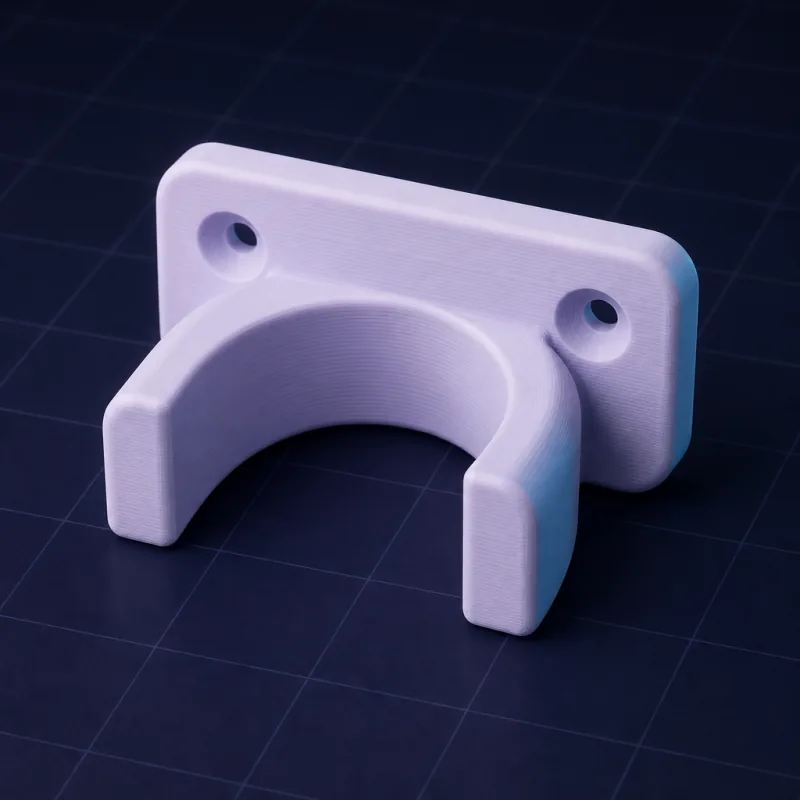
The job
Hold a 32 mm PVC pipe against a plywood wall, 40 mm off the surface, with two screws. Nothing exotic, which is the point: this is the kind of part where iteration usually costs more time than the first draft.
Round 1: the first render (2 minutes)
The render showed a saddle on a stem on a base. The AI's summary listed its assumptions: 3 mm fillets at the stem, countersinks on the screw holes, the base resting flat for printing. Looked right. Downloaded, printed in PETG.
Round 2: the pipe does not sit (1 minute)
The saddle held the pipe at its widest point, so the pipe could roll out. Message: "extend the saddle to wrap 200 degrees around the pipe so it clips on." The ghost overlay showed the extra lip appear; nothing else moved. Re-download was free.
Round 3: the clip is too stiff (1 minute)
The 200° wrap in 4 mm PETG did not flex enough to snap the pipe in. "Thin the saddle to 2.5 mm at the lips and add a 1 mm lead-in chamfer on both lip edges." Two parameters, one render.
Round 4: printing orientation (1 minute)
The stem printed with layers across the load direction and I did not like the look of it. "Add a 6 mm gusset on each side between the stem and the base." Same design, stiffer. Still a minor change.
Round 5: the screw heads sit proud (30 seconds)
I had used pan-head screws. "Change the countersinks to 9 mm counterbores 3 mm deep." Done.
Round 6: four more, different pipe (1 minute)
Three more brackets for a 25 mm pipe. "Make a version for a 25 mm pipe, keep everything else." Because the bore was a parameter, the saddle, lips and stem scaled with it. This was a new design (different part), so a new download; the three prints were identical so one download covered them.
Total
Six rounds, about seven minutes of chat, three prints. At most 9 credits on a plan: the first part at 4, the 25 mm version at 3, four small changes at 2 with the first 3 free (a quick edit that only changes a size spends 1), with both downloads included. The first print was the most valuable minute: it revealed the two things I could not have known from the screen.
What made iteration cheap
- Each edit was one sentence with a number in it.
- Nothing else moved. The screw holes never shifted while I worked on the saddle. That is the property of a parametric program and it is what makes rapid iteration possible.
- The ghost made every change visible without reading a diff.
- Free re-downloads for fixes meant printing the first version early instead of over-thinking it.
Try the same loop
Pick something small you need. Prompt it with the mating dimension first. Print the first version you are not embarrassed by, and let the physical part tell you rounds two to six.
Prompts to start from
Open one in the builder, change the numbers to yours, and the model renders in your browser, usually within a minute or two. Keep adjusting in the chat before you print.A wall bracket for a 32 mm pipe: a half-round saddle with a 33 mm bore wrapping 200 degrees so the pipe clips in, lips 2.5 mm thick with a 1 mm lead-in chamfer, a flat base 60 x 25 mm with two 4.5 mm screw holes 40 mm apart with 9 mm counterbores 3 mm deep, pipe centre 40 mm from the wall, 4 mm thick elsewhere, 6 mm gussets between the stem and the base.
A desk hook for a 25 mm round bag strap: a 30 mm deep hook 12 mm wide, 4 mm thick, with a 40 x 30 mm base and two 4.5 mm screw holes. Make the hook depth and width parameters.
Questions
Two to four for a bracket or holder, four to eight for an enclosure. The first print usually reveals one or two things the screen cannot, and each fix is a single message.
A new part spends 4 credits on a plan, its first 3 small changes free (3 without a plan), a design change 3, a small change 2, a quick edit 1; typing the number in the viewer or tapping Too tight / Too loose in Fit Check is free. Downloads are included in every plan; without one, the download is paid once per design (4 credits), and small fixes afterwards re-download free. A different part (a 25 mm bracket after a 32 mm one) is a new design.
The previous version is shown as a ghost after each change with a one-click undo. You can also describe the previous state and ask to return to it.