How much time does AI save in 3D modelling? Timed on eight real parts
We timed eight everyday 3D printed parts in desktop CAD by a competent user, and again by describing them to an AI. The AI column was 8 to 15 times faster.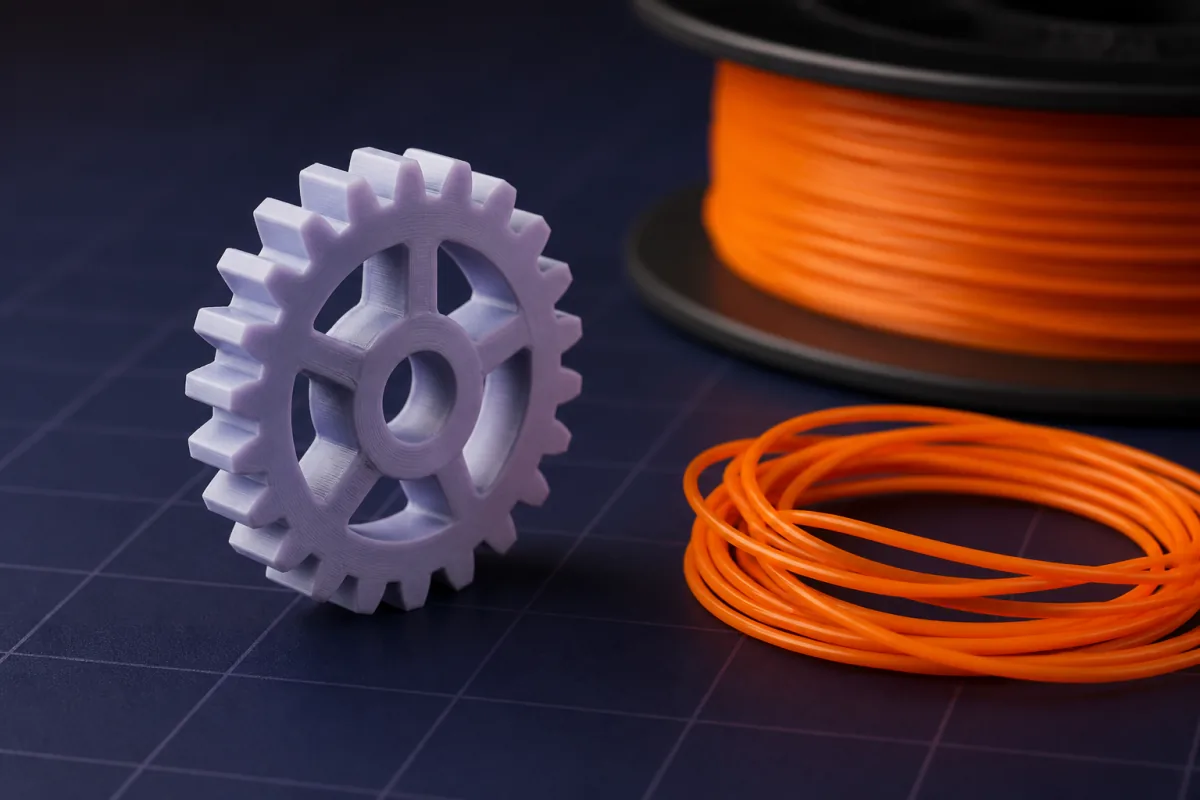
How we timed it
Eight parts that makers print every week. The desktop column is a person comfortable in Fusion 360 (several years of hobby use, not a professional), working from a sketch with the dimensions written down, timed from opening a new design to exporting an STL. The AI column is the same person describing the same part to SpeakCAD, including reading the render, one or two edits, and downloading. Neither column includes printing. These are our timings, not a study; your numbers will differ, but the ratios will not differ much.
We took them in early September 2026, when a first render usually took under a minute. New parts now get deeper reasoning through the geometry, so the first render usually appears within a minute or two: add a minute or so to each AI row. A typical functional part, with a couple of edits and a dimension check, is a downloaded file in about 10 to 15 minutes.
The results
| Part | Desktop CAD | Describing to AI | Ratio |
|---|---|---|---|
| Phone stand with cable slot | 25 min | 3 min | 8x |
| Pipe bracket, two screw holes | 35 min | 4 min | 9x |
| Drawer organizer, 4 compartments | 30 min | 3 min | 10x |
| Knob for a D-shaft with grip ridges | 45 min | 5 min | 9x |
| Spur gear pair, 20 and 40 teeth | 50 min | 5 min | 10x |
| Two-part enclosure, 6 cutouts, standoffs, snap lid | 2 h 40 min | 12 min | 13x |
| Replacement clip from a photo | 1 h 10 min | 6 min | 12x |
| Custom cookie cutter from an outline | 40 min | 4 min | 10x |
| Total | 7 h 35 min | 42 min | 11x |
Where the desktop time goes
- Sketching and constraining. Drawing a rectangle, dimensioning four sides, adding fillets, fixing an over-constrained sketch. 30 to 50 percent of every part.
- Feature order. Deciding whether to shell before or after cutting the port holes, and redoing it when the choice was wrong.
- Fits. Looking up what clearance a snap fit needs in PLA, then modelling the clip geometry by hand.
- The enclosure specifically. Six cutouts positioned by coordinates, four standoffs, a lid with clips, and then making the lid match after the base changed.
- Export and repair. Rare in Fusion, common in mesh tools.
Where the AI time goes
- Writing the prompt. About a minute. Most of it is deciding the numbers, which you had to do in CAD too.
- Waiting for the render. Usually a minute or two for a first version, seconds for small edits.
- Checking. Reading the assumption summary, orbiting the model.
- Edits. One or two short messages.
The AI is not faster at geometry than a CAD kernel. It is faster because you skip the interface: no sketch, no constraints, no feature tree, no menus. The fits, the fillets and the printability rules are applied without being asked.
What the savings do not include
Learning time. The desktop column assumes years of practice; a beginner takes far longer, or gives up. The AI column needs no practice. For someone who does not know CAD, the ratio is not 11x, it is the difference between a part and no part.
Where AI does not save time
Organic shapes (use a sculpting tool), large assemblies with drawings (use desktop CAD), and parts where you already have a parametric file and need a tiny change (open the file; although uploading a .scad and asking is also fast). The savings are concentrated in the one-off functional part, which is most of what gets printed.
A number to remember
Roughly an hour of CAD becomes five to ten minutes of describing. Over a month of weekend printing that is an afternoon returned every week.
Prompts to start from
Open one in the builder, change the numbers to yours, and the model renders in your browser, usually within a minute or two. Keep adjusting in the chat before you print.A phone stand for an 80 mm wide phone at 60 degrees with a 12 mm cable slot underneath and a 2 mm lip.
A two-part enclosure for a 65 x 30 mm PCB with 2.5 mm mounting holes 3 mm from each corner, 12 mm internal height, 2 mm walls, snap-fit lid, USB-C cutout centred on one short side 4 mm above the floor, a 5.5 mm LED hole and a 6.5 mm button hole on the lid.
A pair of spur gears, module 1.5, 20 and 40 teeth, 8 mm thick, with 6 mm D-shaft bores, laid side by side on the bed.
Questions
On the everyday functional parts we timed, 8 to 15 times faster for someone who already knows CAD: an hour of modelling becomes about five to ten minutes of describing and checking. For someone who does not know CAD, it is the difference between getting a part and not.
Skipping the interface. No sketches, constraints, feature ordering or menu hunting; fits and printability rules are applied automatically. The geometry itself is computed just as precisely.
No. They are our own timings on eight real parts with one competent hobbyist user, given here so you can compare against your own. The ratios are consistent across parts; the absolute minutes vary by person.