Hooks, clips and stakes for Halloween decorations, sized to your house
3D print the hooks that hold Halloween up: over-the-door hooks, gutter clips for lights, fence brackets, inflatable stakes and lost battery covers, to your sizes.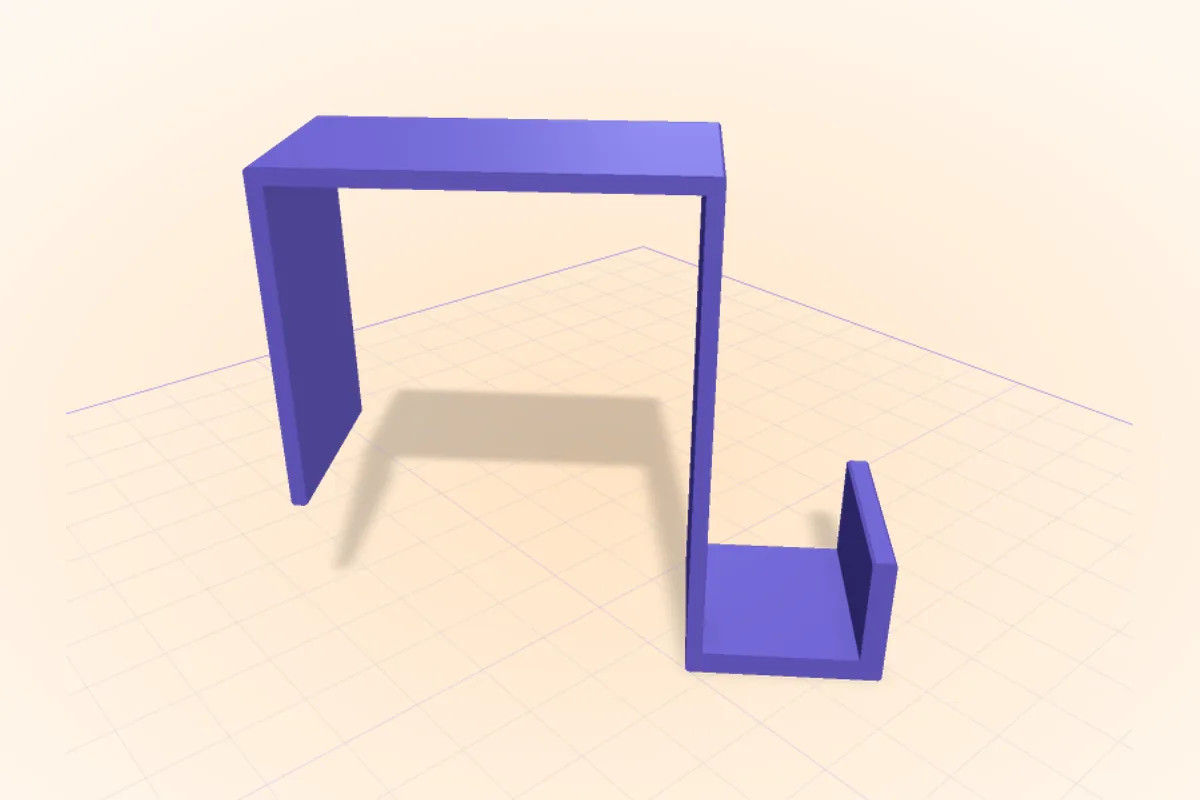
The decorations come out of the box every October. The hooks, clips and stakes that held them up last year are lost, snapped or the wrong size for the new house. They are also the best possible thing to 3D print: small, quick, invisible once the skeleton is up, and impossible to buy in exactly your size.
Each part below is one measurement plus one sentence.
Over-the-door hooks
| Door | Usual thickness | Gap to ask for |
|---|---|---|
| Interior door (North America) | 35 mm (1 3/8 in) | 37 mm |
| Front door (North America) | 45 mm (1 3/4 in) | 47 mm |
| Interior door (Europe) | 38 to 40 mm | 2 mm over yours |
The strap that goes over the top of the door must pass the gap between door and frame: 2 mm thick at most, and wide (20 to 30 mm) for stiffness. A front door with weather-stripping may still bind: print one, close the door on it, then thin it with a quick edit (1 credit) if it rubs.
Light strings: gutters, fascia, windows
- Gutter clips: measure the lip of the gutter (its thickness and how far it curls). Ask for a clip that snaps over that lip and holds a light string's wire, 5 to 8 mm across.
- Window frame clips that press into the gap of a vinyl window frame, no adhesive.
- Spools for the strings, with a slot for the plug, so they come out untangled next year.
Yard and fence
- Fence post brackets for a skeleton, a sign or a light: built around the post's width (a 4x4 post is 89 mm, 3.5 in), screwed or held with a strap.
- Ground stakes for an inflatable: the original thin stakes snap in hard ground. Ask for a T-section stake 200 mm long, 6 mm thick, with a hook for the tether, and print it in PETG: PLA shatters when hammered.
- Sign stakes that slide onto the back of a printed sign.
Fix the decoration itself
- A lost battery cover: measure the opening and the clip, or photograph the cover from the twin decoration next to a ruler and ask for a copy. Copy a part from a photo.
- A broken skeleton joint or a snapped stand: describe what it attaches to, with the pin or hole size.
- A wobbly animatronic that needs a wider base: a ring that clips around its foot.
Outdoors: which plastic
| Plastic | Outdoors in October | For |
|---|---|---|
| PLA | Fine for a few weeks in mild weather; creeps under load | Signs, light clips with no strain |
| PETG | Good; tougher, takes a hammer | Stakes, hooks that carry weight |
| ASA | Best in sun and frost | Parts that stay up all year |
Will it fit the first time?
Hooks and clips depend on a gap of a millimetre or two. Print a thin slice of the hook first: the five-minute fit test, or Fit Check in the editor, which remembers your printer's tolerance for every model after that.
Shaping a part by hand (a hole, a cut, an added shape, text, rounded corners, a shell, every size typed in millimetres) is free, and so is downloading what you shaped. With the AI, a new part or a design change spends 3 credits, a small change 2 credits and a quick edit (a changed size or number) 1 credit; downloads are included in every plan, 4 credits without one. A new free account also gets its first AI part free (not offered in every country): some accounts get the credits right away, others confirm with a card first (a free trial, nothing charged that day); downloading the part spends 4 credits without a plan, like any AI work (every plan includes downloads).
The Halloween code: SPOOKY40
40% off your first month of any plan with the code SPOOKY40, until 2 November (first subscription). It applies itself at checkout when you came through one of these Halloween pages, and you can type it on the payment page too. Start with Maker: 50 credits a month for $7.99, cancel anytime. The hand tools, and the download of what you shape with them, are free without it. Every Halloween part and its prompt on one page: Halloween 3D prints.
Prompts to start from
Open one in the builder, change the numbers to yours, and the model renders in your browser, usually within a minute or two. Keep adjusting in the chat before you print.An over-the-door hook for a 45 mm thick front door: a flat strap 2 mm thick and 25 mm wide over the top of the door with a 47 mm inside gap, 40 mm down on the inside, and on the outside a hook 60 mm down with a 20 mm deep J for a wreath ribbon
A gutter clip for Halloween lights: snaps over a gutter lip 1 mm thick that curls 12 mm inward, holds a light string wire 6 mm across in a C-clip with a 5 mm opening, 15 mm wide, PETG
A replacement ground stake for an inflatable decoration: T-section 200 mm long, 18 mm wide flanges, 6 mm thick, pointed at the bottom, with a 25 mm hook at the top for a 4 mm tether cord
A fence post bracket for an 89 x 89 mm post: a U-shaped clamp 30 mm tall with 3 mm walls and 0.5 mm clearance, two 5 mm screw holes on the side, and a 20 mm diameter peg sticking out 40 mm to hold a skeleton's arm
Questions
Yes. Measure the door's thickness, then ask for a hook with an inside gap 2 mm larger and a strap no thicker than 2 mm so the door still closes. Print it flat; PETG flexes less than PLA over time.
PETG for stakes and hooks that carry weight or get hammered, ASA for anything that stays outside all year. PLA is fine for light parts for a few weeks in mild weather.
Often, yes: measure the opening or the pin it fits, or photograph the intact part next to a ruler, and describe it in SpeakCAD. You check the copy in 3D before printing and change any size in the viewer.