1
Organizers & storage
Glasses stand for several pairs of spectacles
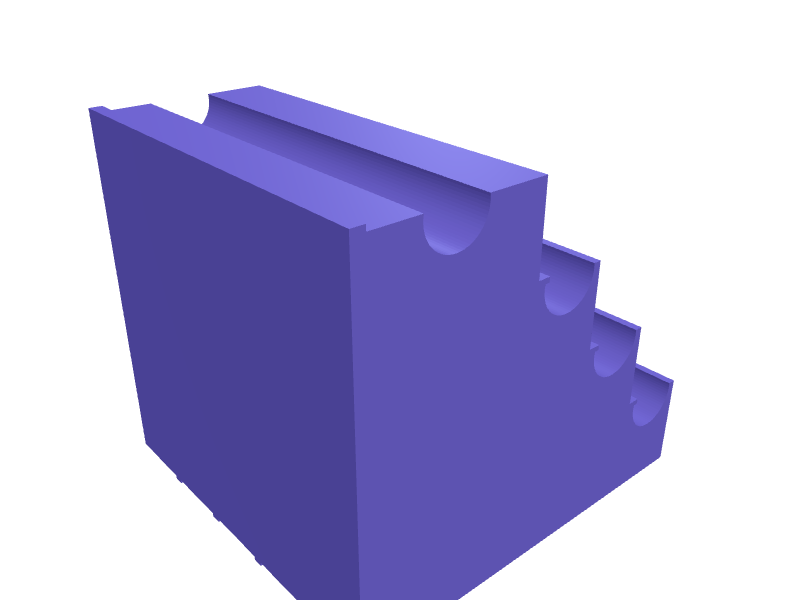
A tiered stand that holds reading glasses, sunglasses and spare frames open-armed, lenses facing out and never touching a surface. Each slot is a 150 mm wide saddle with a 10 mm deep rounded groove for the bridge, tiers step up 35 mm and back 30 mm so frames do not overlap, and the front edge has a 2 mm lip to stop arms sliding off. A 3 mm thick base with 1.5 mm ribs underneath keeps the stand rigid while printing fast. Open the ready-made model free, resize it on your phone or computer, then download a print-ready STL, 3MF or G-code sliced for your printer, free.Opening the ready-made model and downloading it as STL or 3MF are free, no card; AI changes use credits, from Maker at $7.99 a month.No printer? We print this part and ship it to your door. See its priceUpdated
2
Adjust
Change its numbers in the viewer for free, or ask the AI in the chat: wall thickness, hole size, the thing it clips onto. AI changes use 2 credits per request (1 for a quick edit, 3 for a redesign), paid with a plan from Maker at $7.99 a month.3Print
Download a watertight STL or 3MF free, with your numbers and hand edits, or G-code sliced for your printer at the same price. After an AI change the download is included in every plan (4 credits without one).
Dimensions of the ready-made model (editable)
| Parameter | Value |
|---|---|
| width of each tier / whole stand | 150 mm |
| height gain per tier | 35 mm |
| depth lost per tier (recession) | 30 mm |
| total depth of the stand | 160 mm |
| base plate thickness | 3 mm |
| stiffening rib height (these touch the bed) | 1.5 mm |
| rib cross-section width | 4 mm |
| number of ribs across width | 4 |
| radius of rounded bridge groove | 12 mm |
| how deep the groove cuts into the tread | 10 mm |
| front lip height above tread | 2 mm |
| front lip thickness (along Y) | 5 mm |
Example prompt
Create a glasses stand with four tiers each 150 mm wide, stepping up 35 mm and back 30 mm, a 10 mm deep rounded bridge groove centred on each saddle, 2 mm front lips, 3 mm base plate with 1.5 mm stiffening ribs beneath, overall depth about 160 mm.
Fit notes
Frame widths vary from narrow readers to wide wraparound sunglasses, so a fixed stand often fits only some of your pairs. Tell SpeakCAD how many pairs and the widest frame you own, watch it build the stand in the browser, refine the saddle shape in plain words, and download when every pair sits comfortably.
Questions people ask about a glasses stand for several pairs of spectacles
A tiered stand that holds reading glasses, sunglasses and spare frames open-armed, lenses facing out and never touching a surface. Each slot is a 150 mm wide saddle with a 10 mm deep rounded groove for the bridge, tiers step up 35 mm and back 30 mm so frames do not overlap, and the front edge has a 2 mm lip to stop arms sliding off. A 3 mm thick base with 1.5 mm ribs underneath keeps the stand rigid while printing fast.
Click Open it free on this page and create a free account (no card): the ready-made model opens in your browser, on your phone or computer, nothing to install. Change its numbers in the viewer for free and download a watertight STL or 3MF free, or G-code sliced for your printer at the same price. An AI change in the chat uses 2 credits per request (3 for a redesign), and the download after it is included in every plan (4 credits without one). Start with Maker: 50 credits a month for $7.99, cancel anytime.
On this page: open the ready-made model free in a SpeakCAD account (no card), change any dimension in the viewer, then download the STL or 3MF free, or G-code sliced for your printer at the same price.
A shared STL is modelled for someone else's measurements. Here you open the ready-made model free, change it to your measurements in the viewer, then download a file sized for the part you actually own, free as STL or 3MF.
Yes. SpeakCAD slices the part on its servers with OrcaSlicer and your printer's official profile (380+ printers, including Bambu Lab, Prusa, Creality and Elegoo), and you download the G-code (a sliced .gcode.3mf for Bambu Lab printers). G-code sliced for your printer costs the same as the STL: included in every plan, free for a part you shaped by hand, 4 credits without a plan for a part with AI work in it. Pick your printer on the printers page to see its profile.
No. SpeakCAD runs in the browser on your phone or computer: the chat, the 3D engine and the live viewer load in the tab. The only file you download is the finished STL, 3MF or sliced G-code.
Print it your way
More organizers & storage
Framework 16 input-module trayReady-made, opens free. A tray that stores two Framework 16 input modules (numpad, RGB macropad) in 130 × 70 mm wells.Tiered thread spool rack for sewing tableReady-made, opens free. A stepped rack that holds sewing thread spools on angled pegs so the labels stay visible and the thread ends do not unravel into each other.21700 battery storage tray for 8 cells with polarity marksReady-made, opens free. A desktop tray that keeps eight 21700 lithium cells upright and separated, handy for vape, torch, power bank and e-bike battery projects.Bambu Lab AMS desiccant holder tray for silica beadsReady-made, opens free. A vented tray that clips into the unused floor space at the front of the Bambu Lab AMS, between the spool rollers, and holds about 60 g of loose silica gel b…Sony NP-FZ100 battery case for four batteriesReady-made, opens free. A pocketable case that holds four Sony NP-FZ100 batteries, the 38.7 x 22.7 x 51.7 mm pack used by the A7 IV, A7 III, A6700 and A1, in labelled bays with a fl…Festool Systainer3 M 187 oscillator insertReady-made, opens free. A two-part insert for a Systainer3 M 187 that holds a Vecturo or OSC 18, five blades in 2 mm slots, and the charger.