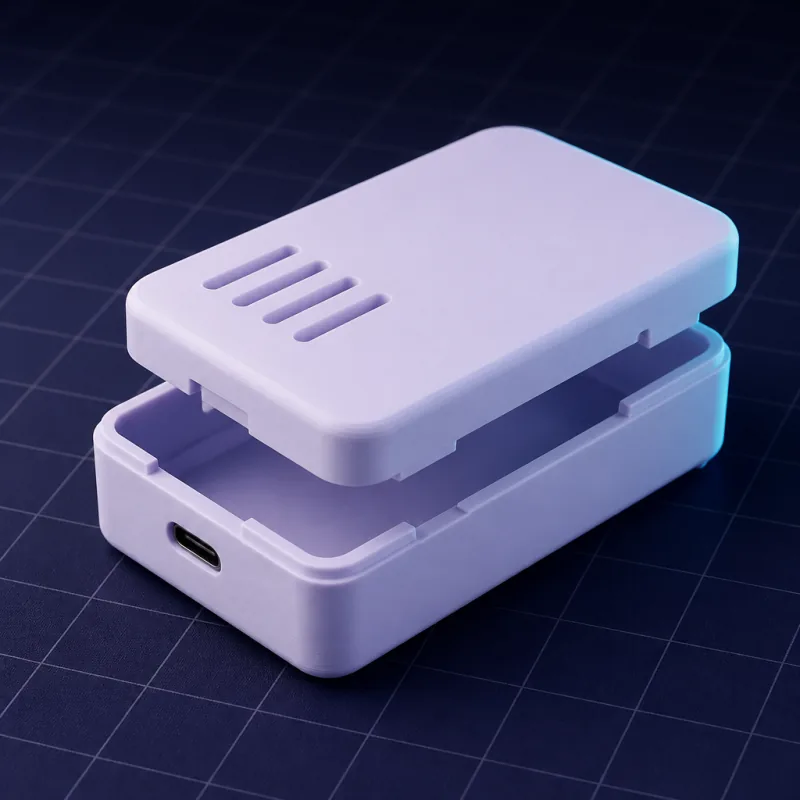
Use case
Genera contenitori per elettronica e scatole per progetti su misura
Ogni progetto di elettronica finisce con la stessa incombenza: una scatola. Esistono generatori di contenitori parametrici, ma si fermano a un rettangolo. SpeakCAD ti lascia descrivere la scheda, le porte, le prese d’aria e come si chiude il coperchio, poi lo perfeziona in chat.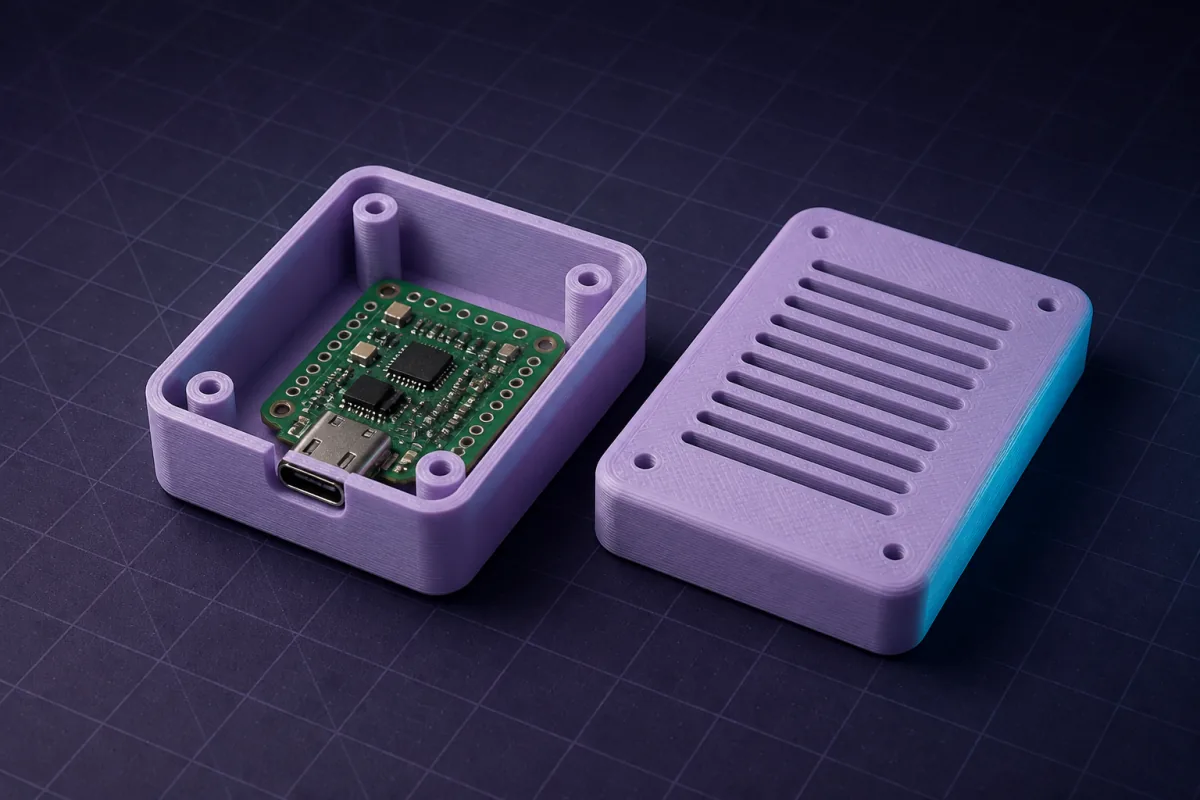
Prompts that work
Copy one, change the numbers to yours, and the model appears in seconds.“Un contenitore in due parti per una PCB da 65 x 30 mm con fori di fissaggio da 2,5 mm a 3 mm da ogni angolo, 12 mm di altezza interna, coperchio a incastro, apertura USB-C centrata su un lato corto.”
“Una custodia per Raspberry Pi 4 con una griglia per ventola da 30 mm sopra, fessure per il nastro GPIO, e occhielli per il montaggio a parete sul retro.”
“Una scatola per sensore da esterno: 60 x 40 x 25 mm interni, pareti da 2,4 mm, coperchio con scanalatura per un O-ring da 2 mm, foro per pressacavo PG7.”
Cosa rende buona una richiesta per un contenitore
Dai le dimensioni interne (o le dimensioni della PCB più il gioco), lo spessore delle pareti che vuoi, come si fissa il coperchio, e dove sono le aperture. Descrivi la posizione delle porte rispetto a un angolo o al centro; l’IA le posiziona esattamente.
Stili di coperchio che SpeakCAD conosce
- Coperchio a incastro con clip a sbalzo, tarate a 0,2 mm di interferenza per PLA/PETG.
- Coperchio a viti con colonnine d’angolo dimensionate per viti M2,5 o M3, o inserti termoinseriti.
- Coperchio scorrevole che scorre in scanalature laterali, ideale per i vani batteria.
- Coperchio a frizione con un labbro di 0,3 mm di gioco per le scatole aperte spesso.
Distanziali, griglie e aperture
Chiedi distanziali per la PCB alle coordinate dei tuoi fori, griglie di ventilazione a nido d’ape o a fessure, guide luminose per LED, fori per pulsanti, finestre per display e pressacavi. Ognuno è un parametro che puoi spostare dopo: «sposta l’apertura USB di 3 mm a sinistra» è un solo messaggio.
Stampabilità integrata
I contenitori si stampano meglio con la faccia aperta verso l’alto e pareti di almeno 1,6 mm per la rigidità. SpeakCAD orienta il guscio e il coperchio piatti sul piano, aggiunge smussi sui bordi inferiori per contrastare l’effetto piede d’elefante, e mantiene la geometria delle clip entro le tolleranze FDM.
Examples from the gallery
Questions
Sì. Nomina la scheda (Raspberry Pi 4, Arduino Uno, ESP32 DevKit C, ecc.) e l’IA usa la sagoma e lo schema dei fori noti. Verifica sempre con la revisione effettiva della tua scheda.
Sì. Le clip sono progettate con 0,2 mm di interferenza e un imbocco a 45° che funziona in PLA e PETG. Se la tua stampante stampa largo, chiedi 0,1 mm di gioco in più.
Chiedi le due parti affiancate sul piano ed esporta una volta sola; entrambe sono nello stesso STL/3MF e le separi nello slicer. Oppure chiedi un pezzo alla volta.
Enclosure guides by board
DIN rail enclosure, 3D printed: a case for a PCB, relay or Shelly that clips onto a 35 mm railThe clip geometry that snaps onto a 35 mm DIN rail, module widths in 17.5 mm steps, terminal access, and a prompt for a rail-mounted ESP32 or relay housing.Weatherproof 3D printed enclosure for an outdoor sensor: gasket, gland, vents and a promptDesign an outdoor sensor box that keeps rain out and lets air in: O-ring groove, PG7 gland, louvres, screwed lid, PETG. With a prompt for an ESP32 weather node.Enclosures for tiny boards: Seeed XIAO, Adafruit QT Py, ESP32 SuperMini and Feather, 3D printedBoards under 25 mm wide need 1.5 mm walls, antenna keep-outs and room for a USB-C plug. Dimensions for XIAO, QT Py, SuperMini and Feather, plus wearable prompts.STM32 Blue Pill and Teensy enclosures: 3D printed cases for boards with no mounting holesThe Blue Pill (53 x 22.5 mm) and Teensy 4.0 (35.5 x 17.8 mm) have no holes and live on headers. How to hold them with rails or pin channels, and prompts for both.Raspberry Pi Pico case, 3D printed: 51 x 21 mm, holes at 47 x 11.4 mm, BOOTSEL accessThe Pico, Pico W, Pico 2 and Pico 2 W share one footprint. Dimensions, hole pattern, how to keep BOOTSEL reachable, and a prompt for a case under 10 mm tall.Raspberry Pi Zero 2 W case, 3D printed: 65 x 30 mm, the 58 x 23 mm holes and a slim snap caseExact Zero 2 W dimensions, the mini HDMI and micro USB positions, camera ribbon exits, and a prompt for a snap-fit case only 14 mm tall.Raspberry Pi 4 and Pi 5 case, 3D printed: the 58 x 49 mm hole pattern, every port, and a promptBoth boards are 85 x 56 mm with M2.5 holes on 58 x 49 mm, but the ports moved. Port positions for the Pi 4 and Pi 5, cooling options, and a snap-fit case prompt.ESP8266 case, 3D printed: NodeMCU V2 and V3 and Wemos D1 mini enclosuresNodeMCU boards come in two widths and the D1 mini stacks shields. Dimensions for each, how to size a case for a shield stack, and a prompt for a vented sensor box.ESP32 enclosure, 3D printed: DevKit C, DOIT V1, S3 and C3 dimensions and a prompt that fitsESP32 dev boards come in a dozen footprints and most have no mounting holes. How to measure yours, hold it with rails, clear the antenna, and generate the case.Arduino Nano case: a 3D printed enclosure for the Nano, Nano Every and Nano ESP32The Nano family shares a 45 x 18 mm footprint with 1.8 mm corner holes. What changes between versions (USB type, height) and a prompt for a tiny snap case.3D printed Arduino Uno enclosure: dimensions, hole pattern and a prompt that fitsThe exact Uno R3 and R4 footprint (68.6 x 53.4 mm, four irregular holes), where the USB and barrel jack sit, and a ready prompt for a snap-fit case with a shield slot.PCB enclosure generator: get a 3D printed case for any board in minutesTurn a PCB's dimensions, hole pattern and ports into a snap-fit or screwed enclosure you can print tonight. Works for Arduino, ESP32, Raspberry Pi and custom boards.
Related use cases
Replacement partsBroken knob, clip, hinge or foot? Describe it with a few measurements and SpeakCAD generates a printable STL replacement in minutes. 7-day free trial.Brackets & mountsDescribe what you need to hold, where it mounts and which screws you have. SpeakCAD generates a strong, printable bracket as STL, 3MF or G-code sliced for your printer in minutes.OrganizersDescribe your drawer or shelf and what goes in it. SpeakCAD generates dividers, trays, bit holders and bins sized to the millimetre. STL, 3MF or sliced G-code export.